They pick a salon at ten at night. You are cutting hair all day.
Two things decide it in seconds: can I see the work, and can I book without ringing anybody. A salon website that gets both right fills the diary while the shop is shut. We build that, and the system behind it that keeps the chair full when somebody cancels.
Cuts, colour, barbering, beauty, nails and treatments. Suffolk and north Essex.
Why does the phone lose you bookings instead of winning them?
Because you cannot answer it, and the person ringing knows that.
- Your hands are in somebody's hair and the dryer is going.
- Whoever is on the other end is standing in their kitchen with a phone, deciding between you and two others.
Every trade page on this site says the number should be enormous. This is the one where that is wrong. Here the number is the thing a customer has to do, and asking somebody to do something is how you lose them to the salon that did not.
What does somebody choosing a salon actually look at?
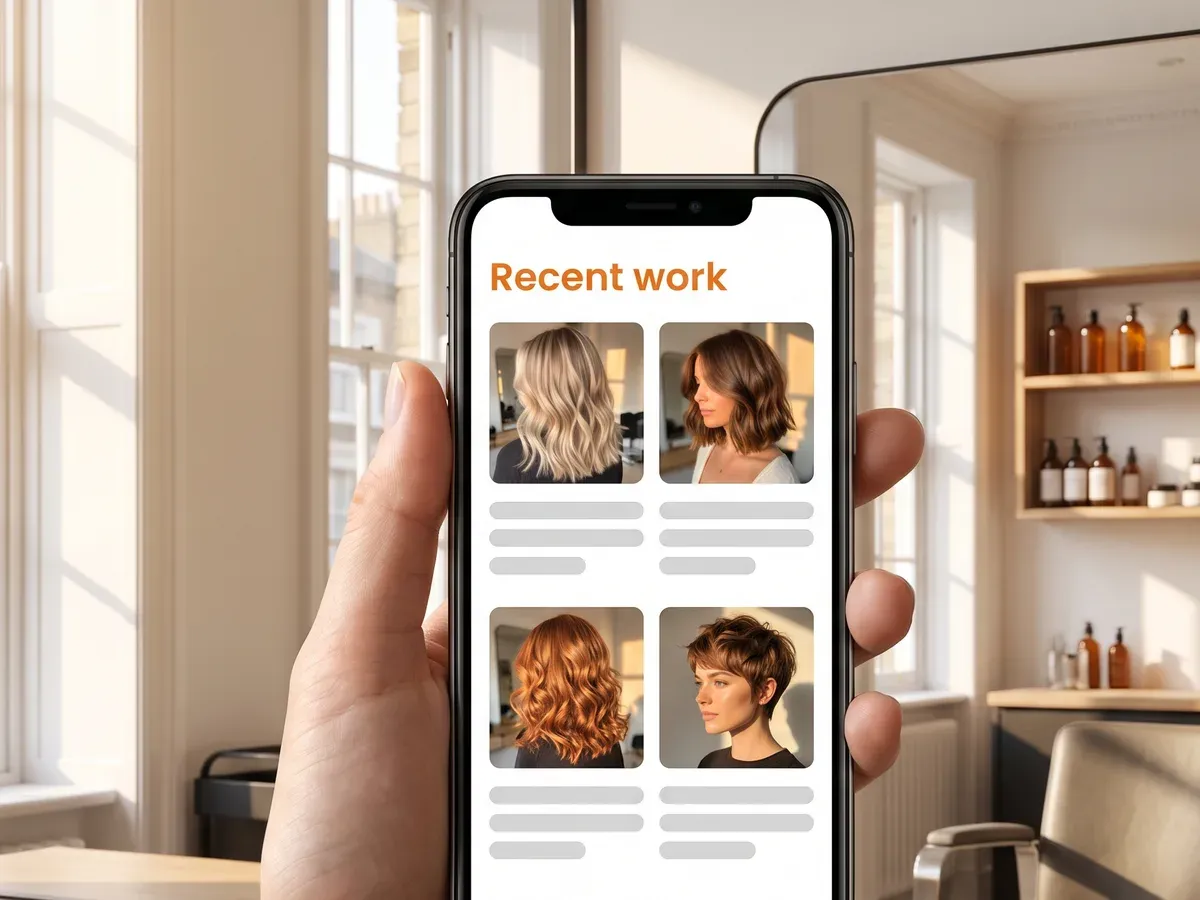
Your work, and almost nothing else. A haircut is bought by looking at one, so the photographs are not proof on this site, they are the product. That changes what the page is made of:
- On a builder's site a gallery is reassurance underneath the words.
- Here it goes near the top, it is big, and the words fit around it.
- Real heads, done in your chair, in your light. A stock photograph of a model with a blow dry says nothing about whether you can cut, and everybody who has ever booked a salon can tell the difference in about a second.
Who is actually on your page at half past nine at night?
Four different people, wanting four different things, and a salon site is usually built for one of them. Naming which is which is what decides the order the page is in.
Somebody whose stylist has left
They are not shopping, they are replacing a person they trusted, and they are nervous about it. They want to see faces and work before they will commit to anybody.
New to the town, six weeks overdue
They have moved and they have put it off. They want to know where you are, what you charge and whether you take somebody new, and they want all three without a conversation.
Booking for something that matters
A wedding, a prom, a christening. This one will ring, because they need to talk it through, and they will book far ahead. What they need from the page is a reason to trust you enough to ring.
A dad booking two boys on a Saturday
Speed, price, and whether he has to wait. He is not reading anything. He wants the earliest slot that takes two of them together, and he will take whichever shop shows him one.
What happens when somebody books at ten at night?

The booking goes straight into your diary, they get a confirmation, and neither of you has to do anything else. That is the whole point of it.
- The booking is safe the second they press the button, so a mail server having a bad evening cannot lose it.
- It is on the same list as every other appointment, rather than in a message somebody has to remember to write up. In the morning you look at one screen and see the day.
- If you would rather approve each one first, it waits there for you to say yes, which is what most single-chair barbers choose.
- They book from the page they are already on, with nothing to download and no account to make.
What keeps the chair full for the rest of the week?
A web designer builds you a page. This is the half that decides whether the diary looks after itself, and five agency sites were measured on 11 August 2026 with not one of them selling any of it.
A cancelled hour gets offered to somebody
An empty two o'clock cannot be sold twice. When one comes free the people who wanted that day are told it is there, instead of the hour quietly disappearing.
Deposits on the appointments that need one
Set which services take a deposit and which do not. Colour and bridal are not a trim, and asking for one on the right bookings is what stops a Saturday morning going empty.
The reminder goes without you sending it
A message the day before, from your name, with the time and where you are. It is the one thing on this page that changes the week.
What you did last time is on the record
The colour, the number, the timings, what they said about the fringe. So a customer never has to explain it again, and anybody covering the chair is not starting from nothing.
Everybody sees their own day on their phone
Who is in, at what time, for what, and what happened last time. One hand, between clients, and it is the same information the front desk is looking at.
The review gets asked for while they still like it
Afterwards, once, in your words, with a link. A person presses send. Nothing goes out under your name that you have not seen first.
How do I stop losing an hour every time somebody cancels?
You cannot stop it, so the job is to sell the hour again before it goes. This is the difference between your trade and most of the others on this site: a plumber who loses a job loses that job, and you lose an hour of a chair that only exists once, gone by six o'clock whatever anybody does.
- The system holds a short list of the people who asked for that day and could not have it, and when the slot opens they hear about it.
- A no-show goes against the record, so you can see who does it repeatedly, which is what decides whether that customer books with a deposit next time.
What does a salon website cost?
The prices are on the home page and they do not change depending on who is asking. Three of the five agencies measured make you request a quote first.
One payment to build it, then a monthly to run it
The build is the site, the words, your photographs organised properly, your Google listing set up and the whole thing live on your own name. The monthly is hosting, changes and keeping it working.
Booking and the diary are the step up
Every plan starts with a page that shows the work and takes an enquiry. Above it is where the booking, the reminders, the deposits and the client record live.
Photographs are worth paying for once
A half day in the shop, in daylight, is the single best thing you can spend money on here, because on this trade's website the pictures are the product rather than the decoration.
Yours to keep
The site is yours, in your name, and so is every appointment and every customer in it. One month's notice, and that month is when we hand the lot over.
Every price we charge is on one page, with exactly what each tier covers.
What salons and barbers ask us
Straight answers about the diary, the chair and the bookings that come in at ten at night.
What actually gets me found for “barbers near me”?
The map results, which for a shop with a door on a street matter far more than the ordinary blue links. So that is where the work goes.
- Your Google and Bing listings set up properly, with your hours and your actual prices on them as text rather than in a picture, because a picture of a price list cannot be read by anything.
- Real reviews, with asking for one built into the end of the appointment so it happens without you remembering.
- A page that genuinely answers what somebody typed, rather than one built to contain the words.
It is easy to spend the whole budget on the blue links, which for you is the wrong half.
How the listing work is done →Do the AI answers know the shop exists?
Some of your customers ask an assistant now instead of searching. They describe the hair they have and what they want doing, and one answer comes back rather than a page of shops. Google writes that kind of answer above the blue links as well.
- An assistant matches facts, not phrases. So the services you genuinely do, the hours you open and what a cut costs go on the page as text, where anything can read them.
- Google's own two AI surfaces are called AI Overviews and AI Mode, and its guide says the work behind them is ordinary search work. There is no fourth thing to buy.
- What we show you is your own Search Console figures, which are real, yours and free. You can see exactly what people searched for to find you.
What catches salons out when they change website?
The bookings already in the old system. Move an ordinary website and the worst that happens is a quiet week. You have a wedding in the diary four months out, and if that moves badly you find out when she turns up and you are not expecting her.
- Every future appointment comes out of the old system and is checked against the new one, name by name, before anything is switched.
- The old booking page keeps working until the day the new one is proved.
- Deposits do not travel. Money taken through the old system sits in somebody else's payment account, so we write down what is where before anything changes.
What is the money actually spent on?
On the pages and the listings that bring somebody into the chair. That is where a salon's money earns its keep.
- A page for every town you really cut hair in. Google filters out the ones aimed at towns a shop does not serve, so those win you nothing.
- Listings in the places a customer would actually look, rather than bought links.
- A page written when there is something real to say, such as a new treatment or a new stylist starting.
How many empty hours did you have last week?
Where your bookings come from now, what happens to the ones you miss while you are working, and what your quiet days look like. Nothing to pay for the conversation.
Nothing to pay, and nothing to sign. We come out to twenty towns across Suffolk and north Essex, and the home page has the prices and what is in each tier.
What else is worth reading?
Every page here answers one question properly rather than skimming five. These are the others, and each one says what it is before you click it.
Websites for dental and medical practices
Most people booking have put it off for years and are dreading the bill. A site that answers both before they have to ask anybody.
Websites for vets and opticians
Half your callers did not choose today, and half are two years overdue a check. One site that is calm for the first and remembers the second.
Foothold AI: websites and AI for local service businesses
A website that gets found, a back office that runs the day, and an app for your team. From £295 to set up and £99 a month. Suffolk based, UK wide.
Where we work: Suffolk and north Essex
Twenty towns across Suffolk and north Essex, from Sudbury. Most are twenty or thirty minutes away, and the person who builds your site comes out.