
AI, built into how the work actually gets done.
We build AI into the jobs your business already does: quoting, chasing, scheduling and the paperwork. Not a chatbot bolted on the front.
Any size, any sector, anywhere in the UK. Scoped and quoted per project.
Everyone says use AI. Where do you actually start?
Every week there is another thing you are apparently supposed to have. Some of it is nonsense and some of it is not. Telling the two apart is a full time job you already do not have time for. So it gets put off, and the feeling of being behind quietly gets worse.
We have been working with AI for four years, since long before it was everywhere. That is the difference between somebody selling you AI and somebody who can actually build it into how your business runs, and it is why we can put you in front of your competition rather than scrambling to catch up with them.
“Are you going to replace my staff?”
No, this does not replace your team. It takes the copying, the chasing and the re-typing off them, so the hours you already pay for go into work that earns.
The point is not fewer people. It is more work through the same doors, with the same people, in the same week. Your team gets faster, your capacity goes up, and nobody has to learn a new career to get there.
Your people do not need to become AI experts. That is our job. Theirs is the work they were good at before any of this started.
Your team will ask what this means for them. We will help you answer it, in plain words, before anything goes live.
The full answer, with the figures behind it →What happened last time a technology arrived like this?
Nobody went out of business the week the internet arrived. They lost, slowly, to the ones who got there first, and by the time it was obvious the gap was too big to close.
The firms that got a proper website took the work
Not from anyone doing worse work. From firms doing exactly the same work, who were simply harder to find and slower to answer. You watched it happen.
Speed decides it, and it always did
The quote that lands the same afternoon beats the one that lands on Thursday, even when Thursday's is better. If a competitor answers in minutes and you answer in days, quality stops being the argument.
The cost is invisible, which is what makes it dangerous
Nothing breaks. No customer complains. You simply never hear about the enquiries that went elsewhere, the same way you never hear about a missed call.
You do not have to do all of it
You do have to start. One process, done properly, teaches you more about what this is worth to your business than any amount of reading. The gap does not close on its own, it widens.
What makes an AI project work?
Mapping the real process, deciding what happens when it gets something wrong, and owning it after launch. The model itself is the easy bit now. That is the work, and it is the reason we scope before we quote.
Which jobs are worth automating?
If a person is doing it, it is repetitive, and it follows rules they could explain to a new starter, it is worth looking at.
Quoting and estimating
Enquiry in, priced quote out, in the format you already use, with a human approving it before it goes anywhere near a customer.
Chasing and following up
Quotes that never got answered, invoices going past due, jobs waiting on a part. The work nobody enjoys and everybody forgets.
Reading documents
Pulling the numbers out of invoices, delivery notes, timesheets, specifications and surveys, and putting them where they were going to be typed anyway.
Answering the same question
Internally for staff, or externally for customers, drawing on your own documents rather than on whatever a general model happens to believe.
Scheduling and dispatch
Who goes where, in what order, when something changes at half past seven in the morning.
Systems that will not talk
The accounts package, the CRM, the spreadsheet somebody built in 2019 that the whole company depends on. Usually the real problem.

How does a project actually run?
No twelve month discovery phase, nothing signed off on a slide, and no platform to buy before anybody knows whether it works.
Find where the money is going
We sit with the people doing the work and follow the process as it really runs, not as the manual says it runs. You get a written map of it either way, and it is yours whether you continue or not. This first step is also sold on its own, from £750, as an AI consulting review, if what you want is the answer rather than the build.
A fixed quote, before any build
Scope, exactly what it covers, what it connects to, who approves what, how errors are handled, and what it costs to run each month. Fixed, in writing, before you commit.
Build the one that pays first
Working software against your real data, not a demo on sample data. Running alongside the humans until it has earned the right to be trusted.
Then decide about the next one
With a real number in front of you for what the first one saved, so the second one is a decision rather than a hope.
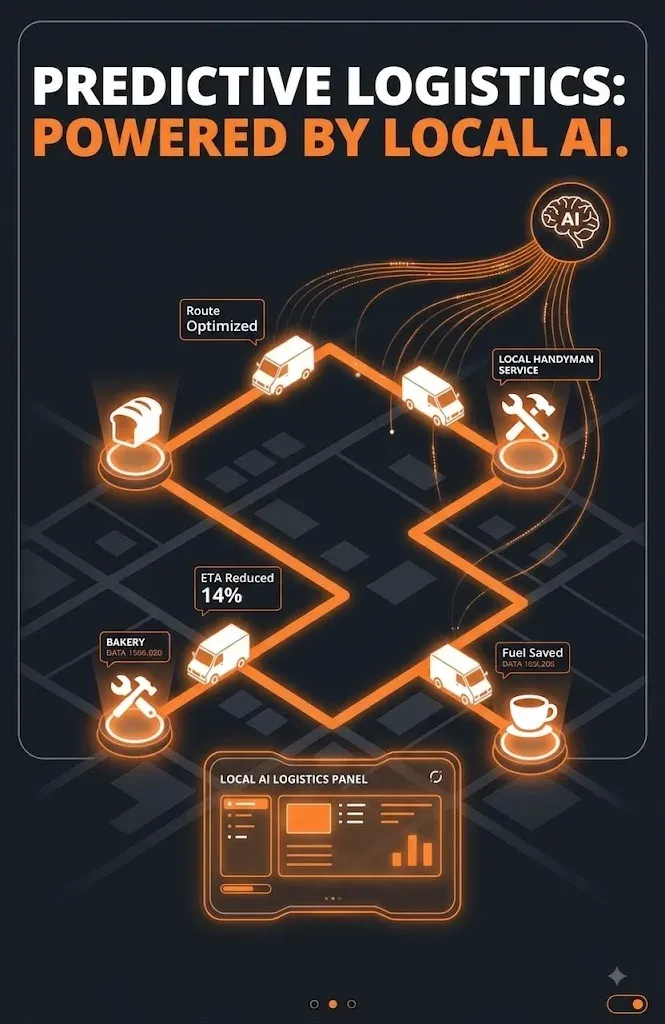
What actually changes on a Monday morning
Your people stop doing the parts of the job the software should be doing. They spend the time on the parts you hired them for.
We start by watching the work as it really runs, rather than as the manual says it runs. Three things come out of that, every time.
- The mundane. The quote that gets typed out twice because two systems do not speak to each other. The inbox somebody reads at half past seven so that nothing is missed. The spreadsheet from 2019 that the whole month depends on.
- The shortfall. The point where a job waits two days because one person has to be in the room. Nobody planned that. It grew.
- The handover. The moment work moves from one desk to another and slows down. That gap is usually where the money is.
Then we build the one that pays first. Not a demonstration on made-up data. Working software on your real jobs, running beside your people until it has earned their trust.
And it is not only the jobs your team already does. Most of what a build like this is worth sits in the work nobody has ever had an hour spare for.
- Every one, not most of them. Every enquiry answered, every quote followed up, every customer asked for a review, every unpaid invoice chased. The follow-up that wins a job is the one that always got missed on a busy week.
- The hours you are shut. Somebody who rings at eight at night gets an answer, and your team gets the details on Monday morning instead of a voicemail.
- Everything you already know and cannot reach. Years of jobs, quotes and notes nobody has time to read, asked a plain question and answering it in a sentence.
- The same standard on a bad day as on a good one. Nothing is forgotten because Thursday was chaos.
So what your team gets back is not a stopwatch. They stop being the thing that has to remember everything, and the business takes on more work without taking on more people.
Talk us through one week of yours →How do we get you found by ChatGPT?
By building the site properly, which is already in what you pay. Assistants assemble their answers out of pages that already rank, and Google says in its own guide for site owners that the work behind its AI answers is ordinary search work. So it is part of the build rather than an extra line.
- It never appears as a line on an invoice from us. It is part of building the site properly, so there is nothing extra to buy.
- What it actually takes is dull: a heading for each real question, the answer in the first sentence under it, and the facts written as text rather than drawn inside a picture.
- Where a bespoke build genuinely earns its money is further in, in the process behind the business rather than the words on the front of it. That is what the rest of this page is about.
What does AI implementation cost?
We scope first, then quote a fixed price in writing, before you commit to anything.
And we tell you what moves that price, so you can work out roughly where you sit before you speak to anyone:
How many systems it has to touch
One system with a decent API is straightforward. Four systems, one of which is a spreadsheet and one of which has no API at all, is most of the work.
How much a mistake costs you
Something that drafts an internal summary needs far less checking than something that sends a price to a customer. The checking is the expensive part, and it is the part worth paying for.
How tidy the information is
If the knowledge lives in three people's heads and a folder of PDFs nobody has opened since 2021, that gets sorted out first. It is usually worth doing on its own.
Whether it has to run itself
Something a person triggers and reviews is a different job from something running unattended at three in the morning that has to be right.
And there are only three shapes it comes in.
Set it up once, it just runs
Review requests, email automation, follow-ups and reminders. You pay to have it built and wired into your site and your back office, and after that there is nothing more to pay.
Anything that answers the phone
Call answering and text-back cost money every time they run, because phone minutes and text messages are not free. You pay to have it built, then the running cost at what it costs us, itemised. No markup hidden in a round number.
Built here first, and running
Everything we build for you is running at Foothold AI before it is offered to you. So you get told what it does on a Tuesday morning rather than what it does in a brochure.
You get a fixed written quote before any build starts, with the running costs itemised separately.
What happens after it goes live?
Both of these are settled in writing before you commit, so the answer is the same on the first day and in a year.
Who looks after it once it is live?
We do, and there is nothing for you to log into. Watching it, keeping it working and fixing it when it breaks are all our side of the line.
- What it costs to run was in the quote you signed, itemised, so looking after it is not a bill that turns up later.
- When the way you work changes, the thing changes with it. You tell us what moved. Nobody has to work around software that was built for last year.
Who decides what it does on its own?
You do, and you made that decision before it was built. The fixed quote names what it may do by itself and what waits for a person. That line does not change afterwards without you.
- You choose where a person stays in the middle, job by job. Anything that reaches a customer or moves money is the obvious place to keep one, and we build to what you decide.
- What it does when it is unsure is written down too. Handing the job back to a person is a normal answer, and it is built in on purpose.
Running a trade, a salon or a practice?
Then the thing costing you money is probably not a bespoke build. It is the calls you cannot take when your hands are full, the quotes nobody chased, and the reviews nobody asked for. All three are already built, already priced, and each one has its own page.
Carrie is our AI receptionist and she covers seven channels, starting with the phone. Your phone rings first, every time. The call you could not take at twenty past seven in the evening still turns into a job on your phone.
Enquiry chasing goes back to the quotes that were never answered, review requests ask at the moment the customer is happiest, and our AI marketing turns the jobs you have finished into the reason somebody rings you next.
All of it sits on the website, the back office and the staff app, at published prices starting at £295 to set up and £99 a month. All of it is a fraction of the cost of a bespoke build, and every figure is on the page before you ring anybody.
See the AI receptionist All four services, and what each is for
Where do the claims on this page come from?
Published guidance from the companies that run the search engines, plus the Government's own business survey, all read on 18 August 2026. None of it is ours, none of it is behind a login, and any of it will contradict us if we have got something wrong.
- Google's AI optimisation guide. Google's own instructions for being found by AI answers, including a list headed what you do not need to do. Read it before anybody sells you an AI search package.
- Google on AI features and your website. What appears in AI Overviews and AI Mode, and the controls you have over it.
- The Bing webmaster guidelines. Microsoft's rules, written around Copilot and grounding rather than around ten blue links. The section on crawling explains why content that only appears after scripts run may never be quoted.
- The UK Business Data Survey 2026. Published 18 June 2026 by the Department for Science, Innovation and Technology. How many businesses of each size actually use AI, counted rather than estimated.
- Google on links. The page that says citing your sources helps establish trustworthiness, which is why this list exists at all.
Which job would you hand over first?
One process, the one that costs you most. Tell us which and we will tell you what it would take. Nothing to pay for the conversation.
Nothing to pay, and nothing to sign. If you would rather write it down than talk, the contact page has a short form, or just email hello@footholdai.co.uk and ask anything you like.
What else is worth reading?
Every page here answers one question properly rather than skimming five. These are the others, and each one says what it is before you click it.
Foothold AI: websites and AI for local service businesses
A website that gets found, a back office that runs the day, and an app for your team. From £295 to set up and £99 a month. Suffolk based, UK wide.
Where we work: Suffolk and north Essex
Twenty towns across Suffolk and north Essex, from Sudbury. Most are twenty or thirty minutes away, and the person who builds your site comes out.
Websites for electricians that bring in work
A website for an electrician, the back office it feeds and the app your engineers use on site. Published prices, no lock-in, and you own it all.
Websites for plumbers and heating engineers
When the heating goes they ring whoever answers. A site that says you are Gas Safe registered and takes the job, plus the back office behind it.