A website for a builder, and the bit that chases the quote.
A builder does not usually lose work to a missed call. He loses it to a quote that went out six weeks ago and never came back. We build the site, the back office that follows the quote up, and the app your lads use on site.
Extensions, loft and garage conversions, renovations and new build. Suffolk, Essex and anywhere in the UK you can reach.
Why do builders lose the quotes they never hear back about?
Because nobody follows them up, and the reason nobody follows them up is that it feels like begging.
A customer asks several builders for a price on an extension. They take weeks to decide, talk to their partner and get a mortgage figure. By then the quote is at the bottom of a pile.
The builder who rings once, politely, is very often the only one who does, and that is usually the whole difference between the two prices.
How a quote gets followed up →What does a builder's website actually need to do?
Four things, and for this trade the quote follow-up is what turns them into money. The site brings the enquiry in and the back office makes sure the biggest quote you will send this year gets answered.
Show finished jobs, not a stock kitchen
Extensions, loft conversions, knock-throughs, renovations. Somebody spending this much wants to see jobs like theirs, finished, in houses that look like their house. Honest photographs of a finished extension sell better than a three dimensional walkthrough of one nobody has agreed to build yet.
Take an enquiry that is worth taking
What they want doing, roughly when, and roughly what they have to spend. Not to qualify anybody out, but so the first conversation starts somewhere real rather than with twenty minutes of guessing.
Say what happens next, and how long it takes
A visit, a written quote, a start date. Somebody having building work done for the first time is quietly worried about being taken for a ride. Telling them the order of events settles that.
Get in front of somebody who has not heard of you
A page for each job you do and each town you work in, built so Google and the AI assistants can read every word without anything having to load first.
How do I follow up a quote without chasing?

By having the system remember, so you are answering a reminder rather than deciding to ring somebody.
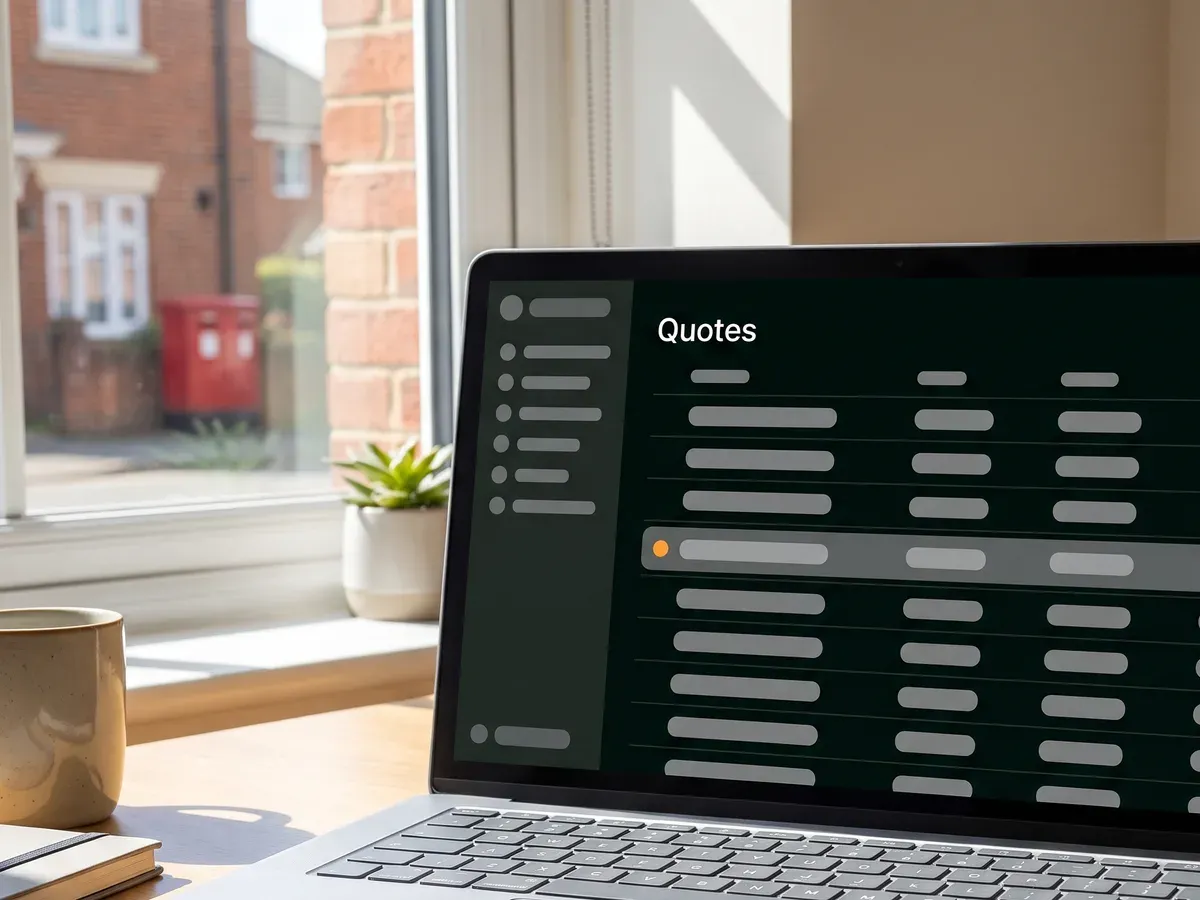
Every quote in the back office carries a value, a date and a status, and the ones nobody has answered come up on the screen as a list rather than staying in your head.
The follow-up itself is one message from your own address, and a model can draft it while you are on site, but nothing goes out until you have read it and pressed send.
That last part is not caution for its own sake: software cannot know whether the job has already been given to somebody else, and a chirpy automatic chase after a bereavement is the sort of thing a small builder never lives down locally.
How the chasing is done for you →What happens to an enquiry after it arrives?
The enquiry becomes a quote, and then the quote becomes something the system chases so that you do not have to. Nobody asks that question until six months in, by which point they have lost count of what went out and never came back.
Five agency sites were measured on 11 August 2026 and not one of them sells anything that happens after the form is submitted.
The enquiry lands in your own back office
Every enquiry on one list, with where it has got to, instead of an email you have to remember. It is safe the second they press send, so an email provider having a bad afternoon cannot lose you a job.
The quote gets a value and a date
So the list can tell you what is outstanding, what it is worth, and which ones have gone quiet. For a trade with a six week decision, that list is the most valuable screen in the business.
You answer it from the same screen
The reply goes from your own domain, in your name, and the exact words are kept against the enquiry. When they reply, that comes back in automatically and sits under it.
The enquiry becomes a job with a history
Quote to job, job to stages, stages to invoiced. Six months later, when somebody asks what was agreed in March, the answer is on the record instead of in an argument.
Your lads see it on their phones
Today's work, the address, the access and the customer, and work marked done with photographs. Built for one hand, outdoors, on a bad signal.
AI goes on top, only when it earns its keep
Drafting the follow-up, chasing the quote nobody answered, pulling figures off a supplier invoice. Always as a draft a person approves, never sent on its own.
The back office comes with Growth and Full.
How do I stop arguments about what was in the price?

By writing the change down when it happens, on site, with a photograph, instead of remembering it at the end.
Every builder has had the conversation about whether something was in the quote, and it is almost never dishonesty on either side: it is six weeks of small decisions made in a hallway with nobody taking a note.
Extras go on the job as they are agreed, with the date, the price and a picture, so the final invoice is a summary of things the customer already knew about.
It is the least exciting feature we build and it is the one that protects the relationship, which on a job this size is what brings the next one through a recommendation.
 How a customer signs for extras on site →
What goes on the page about schemes and registrations?
Whatever is true for you, checked on the issuing register with the date written down. If you are FMB registered we show it in plain text with your number, because it is a signal anybody can go and check.
The Federation of Master Builders describes itself as the UK's largest trade association for the construction industry. It says members go through a strict vetting process and an inspection of their work before they can join, so it is worth showing properly.
Your insurance, your guarantee and six finished jobs somebody can go and look at carry just as much weight. They go on the page too.
How the words get written and checked →How much does a builder's website cost?
Our prices are on the home page and they do not move depending on who is asking. Three of the five agencies measured make you request a quote, which usually means the number is decided after they have seen how much you can afford.
A one-off to build it, then a monthly to run it
The build is the site, the copy, the photographs organised, the Business Profile set up and the whole thing put live on your own domain. The monthly is hosting, changes, and keeping it working.
For this trade, the back office is the point
Every plan starts with a website that works properly. For a builder the tier above it is where the money is, because that is the one that tracks the quote. Said plainly rather than upsold.
Anything we pass through, we say so
Your domain, and your advertising budget if you run ads, are yours and go straight to whoever provides them. Our fee is our fee and it is never quoted as though it covered your spend.
Yours to keep
The site is yours, in your name, and so is everything in it. One month's notice, and that month is when we hand the lot over.
Where your money goes
- A page for every town you genuinely build in. Google filters out pages aimed at towns you never work in, so those win you nothing and we do not make them.
- Listings on the registers a builder's customer actually looks at. Earned entries, never bought links.
- A page written when there is something real to say, like a finished extension worth showing, rather than a post a week about nothing.
- Website chat when the traffic is there to make it worth watching. You are on site all week, so until then every pound goes into being found.
- Your FMB number if you hold one, and any scheme that genuinely gave you a badge, in text a customer can look up in seconds.
Every price we charge is on one page, with exactly what each tier covers.
Will an assistant put us on the shortlist?
People research a build for months and ask an assistant most of it. What an extension costs, how to pick somebody, what tends to go wrong. Those answers name firms, and Google writes one of them above the blue links on an ordinary search.
- The money question is asked first, and it belongs on the page. A page giving a real range, and saying what moves it, is the page that gets quoted back.
- Assistants match stated facts. The work you take on, the size of job you want, your insurance and your guarantee all have to be on the page rather than in your head.
- The work is the same work. Google's own guide says the best practices for search still apply, so there is no fourth thing to sell you.
What else is worth reading?
Every page here answers one question properly rather than skimming five. These are the others, and each one says what it is before you click it.
Websites for landscapers and gardeners
The work arrives in a rush every spring and then the phone stops. A site that takes the rush, a gallery you fill from your own phone, and the round.
Websites for decorators that quote first
Three decorators look at the same hallway and the one who sends the price that evening gets it. A site and a back office built for that.
Foothold AI: websites and AI for local service businesses
A website that gets found, a back office that runs the day, and an app for your team. From £295 to set up and £99 a month. Suffolk based, UK wide.
Where we work: Suffolk and north Essex
Twenty towns across Suffolk and north Essex, from Sudbury. Most are twenty or thirty minutes away, and the person who builds your site comes out.
What would it be worth to have every quote chased?
Tell us roughly how many are sitting out there and what they are worth, and we will tell you what it would take. Nothing to pay for the conversation.
Nothing to pay, and nothing to sign. If you would rather read first, the home page has the prices and everything that is in each tier, and AI implementation is the separate track for automating a process rather than building a site.