A website for a landscaper that fills the diary both ends of the year.
A website for a landscaper is doing two jobs at once, because the maintenance round and the big build are not the same business and never have been. We build the site, the back office that holds both, and the app your lads use in the garden.
Maintenance rounds, design and build, fencing, turf and hard landscaping. Suffolk, Essex and anywhere in the UK you can reach.
Why do all the enquiries arrive in the same three weeks?
Because the grass starts growing and everybody looks at their garden on the same warm Saturday. That is the shape of this trade and no website will change it, but it does decide what the website has to be good at.
In the rush you cannot answer the phone, so the enquiries you lose are the ones that rang while you were on a mower. In November the phone is quiet and the fencing, the turfing and next year’s builds are sitting in other people’s heads.
A site built for a plumber solves neither of those, and that is what this trade usually gets sold.
Who answers them while you are on a job →What does a landscaper's website actually need to do?
Four things. The first one is the obvious one, and it is the one that matters least once somebody has decided you look all right.
Show the garden, not the company
The before and the after, side by side, of a garden that looks like theirs. This is the one trade where the work photographs itself, and the pictures are already on somebody's phone.
Take the enquiry while you are on a mower
Ear defenders on, hands filthy, and the phone in the van. A form that takes a photograph of the garden and a postcode catches the job you would otherwise ring back about on Thursday. The size, the access and the picture arrive with it, and you pick the slot once you have seen all three.
Say honestly how far out you are booked
In April that is the difference between a waiting list and a lost customer. People will wait for somebody who told them how long the wait is. They will not wait for silence.
Sell something in the winter
Fencing, turfing, clearance and the builds that get designed in the cold and dug in the spring. A page for each of those is what fills a quiet November, and it has to exist before November.
Can I put my own photographs up without ringing anybody?
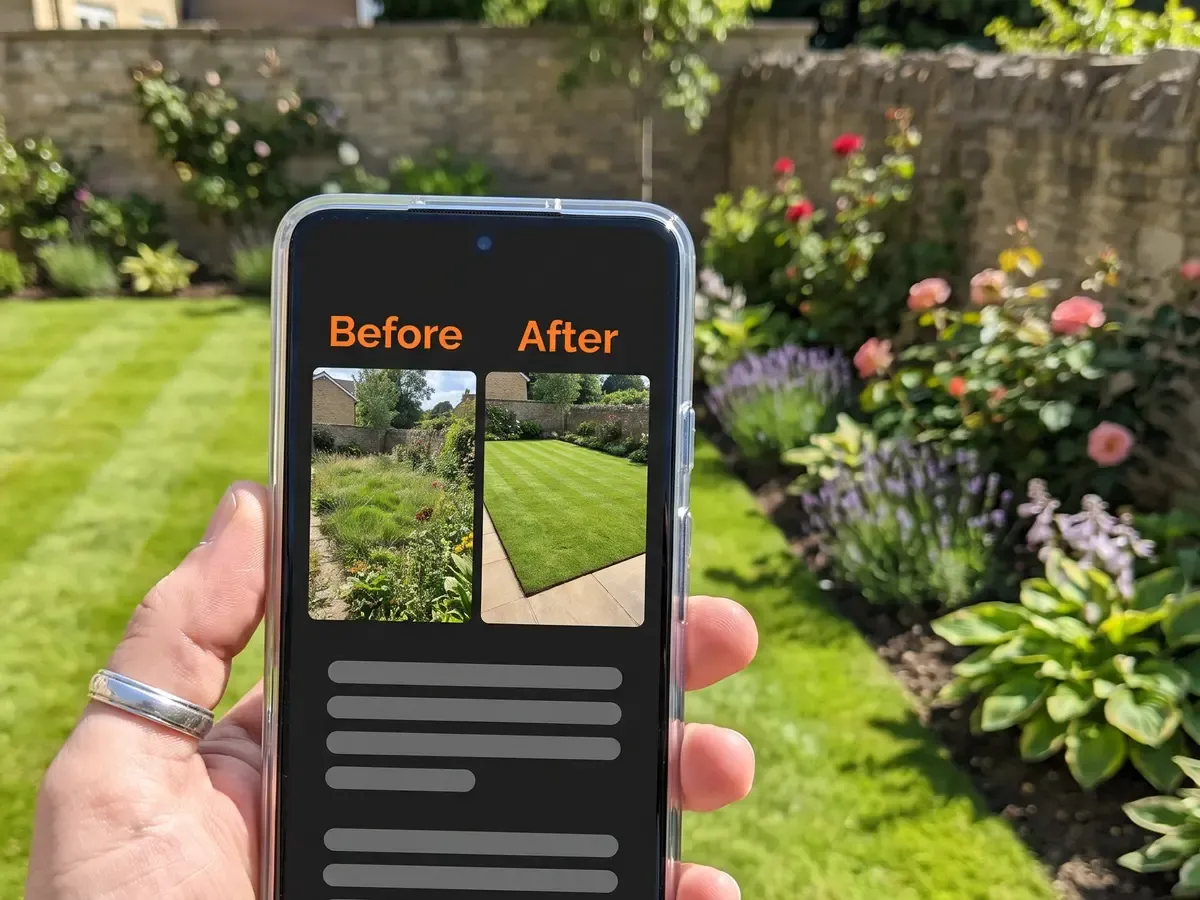
Yes, and on a landscaping site that is the whole point of the build. The gallery is a block in your own back office: you pick the before and the after, type one line about what the garden was like, and it is on the site. No email to us, no waiting until Monday, no charge for a content update.
That matters more here than on any other trade we build for, because a landscaper’s gallery is the product, and a gallery that stopped in 2024 says more about the business than any paragraph on the page.
The pictures come off the phone that was already in your pocket when you finished the job, which is the only version of this that ever actually happens.
What a back office does with a before and after →What happens to an enquiry after it arrives?
The enquiry joins a list that can survive the three weeks when a season's worth of them arrive at once. Nobody asks that question until six months in, by which point the busy spell has been and gone. Five agency sites were measured on 11 August 2026 and not one of them sells anything that happens after the form is submitted.
The enquiry lands in your own back office, photograph and all
Every enquiry on one list, with the message and the picture of the garden together. It is safe the second they press send, so an email provider having a bad afternoon cannot lose you a job.
You answer it from the same screen, at seven in the evening
The reply goes from your own domain, in your name, and the words are kept against the enquiry. When they answer, that comes back in automatically and sits underneath it.
A one-off becomes a round, and the round keeps itself
The maintenance side is the same gardens every fortnight, and it is where the steady money is. Once a customer is a round rather than a note in a diary, nobody has to remember them.
The weather moves a day, not a fortnight
When Tuesday is washed out the jobs move together and the customers are told, rather than four separate phone calls made from a layby at half past seven in the morning.
Your lads see the round on their phones
Today's gardens in order, the address, the gate code, where the tap is and which dog bites. Marked done with a photograph. Built for one hand, outdoors, on a bad signal.
AI goes on top, only when it earns its keep
Drafting the reply, chasing the quote nobody answered, turning a finished job's photographs into a gallery entry. Always as a draft a person approves, never sent on its own.
The back office comes with Growth and Full.
How do I keep the round and the build work in one place?

By treating them as two different things in the same system rather than pretending they are one, which is what a diary and a notebook end up doing badly.
A round is recurring, low value and the same faces every fortnight, and what it needs is a schedule, a visit marked done and an invoice that goes out without anybody typing it. A build is a single job worth thousands, decided over a month, and what it needs is a quote that gets chased and a record of what was agreed.
Put them in one back office and you can see the thing that actually runs this trade: how much of next month is already committed, and therefore whether you can say yes to the patio. Most software for this trade is built for one of the two, and the half it ignores is the half you end up doing on paper.
How the work is kept in one place →What goes on the page about registrations?
This trade has three public registers a customer can search, which is more than most. We put whichever ones you hold on the page in plain text with the number.
- The British Association of Landscape Industries describes itself as the UK’s leading trade association and accreditation body for landscaping professionals, and lists over 900 accredited members in a public directory.
- The Association of Professional Landscapers is the only landscaping scheme operator of TrustMark, and says every member is inspected annually for insurance, health and safety and quality of work.
- The public register of waste carriers, brokers and dealers. If you carry waste away, GOV.UK is plain that a business which transports waste has to register, and that once you have, your details appear on it.
So a scheme only ever appears on a page we build when somebody has looked it up on the issuing register and written down the date they checked.
For a gardener taking away a van of green waste every day, the waste carrier registration is the one worth putting up. Your insurance and photographs of finished gardens carry the same kind of weight, so they go on the page too.
How the words get written and checked →How much does a landscaper's website cost?
Our prices are on the home page and they do not move depending on who is asking. Three of the five agencies measured make you request a quote, which usually means the number is decided after they have seen how much you can afford.
A one-off to build it, then a monthly to run it
The build is the site, the copy, the photographs organised, the Business Profile set up and the whole thing put live on your own domain. The monthly is hosting, changes, and keeping it working.
The round is the reason to move up a plan
Every plan starts with a website that works properly. The recurring schedule, the visits and the app your lads use are the ones above it, and on this trade that is where the time goes back.
Anything we pass through, we say so
Your domain, and your advertising budget if you run ads, are yours and go straight to whoever provides them. Our fee is our fee and it is never quoted as though it covered your spend.
Yours to keep
The site is yours, in your name, and so is everything in it. One month's notice, and that month is when we hand the lot over.
Where your money goes
- A page for every town your round genuinely reaches. Google filters out the ones aimed at towns you do not drive to, so those win you nothing.
- Listings on the registers a homeowner planning a garden actually looks at. Earned entries, never bought links.
- A page written when there is something real to say, like a finished garden worth showing, rather than a post a week about nothing.
- Live chat once the site is busy enough for somebody to answer it. You are on a mower most of the day, so the money goes into being found first.
- Your own registration number and the schemes that really gave you a badge, in text a customer can look up in seconds.
Every price we charge is on one page, with exactly what each tier covers.
Do the AI answers know what we do?
People ask an assistant what to do with a garden long before they ask who does it. The reply comes back with ideas and often a name. Google now writes that kind of answer above the blue links on an ordinary search.
- Assistants match plain facts. Whether you do drainage, whether you take maintenance as well as builds, the size of job you want and how far you travel all belong on the page.
- Photographs of real work still do the selling, and each one needs a written caption. A picture with nothing beside it cannot be read by any of this.
- The work is the same work, in Google's own words, so nobody has to pay for it twice.
What else is worth reading?
Every page here answers one question properly rather than skimming five. These are the others, and each one says what it is before you click it.
Websites for decorators that quote first
Three decorators look at the same hallway and the one who sends the price that evening gets it. A site and a back office built for that.
Websites for cleaning companies
You do not sell a job, you sell the same Tuesday for years. A site that opens the door and a back office that holds the rota when somebody is off.
Foothold AI: websites and AI for local service businesses
A website that gets found, a back office that runs the day, and an app for your team. From £295 to set up and £99 a month. Suffolk based, UK wide.
Where we work: Suffolk and north Essex
Twenty towns across Suffolk and north Essex, from Sudbury. Most are twenty or thirty minutes away, and the person who builds your site comes out.
What would a full diary in November be worth?
Where the enquiries come from, what happens to them, and how much of the round is being held together by memory. Nothing to pay for the conversation.
Nothing to pay, and nothing to sign. If you would rather read first, the home page has the prices and everything that is in each tier, and AI implementation is the separate track for automating a process rather than building a site.