A website for a roofer that gets the job priced.
A website for a roofer has a harder job than most, because the customer cannot see the thing they are buying and has usually been knocked on by somebody in a van already. We build the site, the back office it feeds, and the app your team uses up on the scaffold.
Pitched and flat, domestic and commercial. Suffolk, Essex and anywhere in the UK you can reach.
Why do roofers get judged before they quote?

Because the trade has been used as cover by people knocking on doors, and every customer has heard the stories.
So by the time somebody rings you they are already checking whether you are the other sort, and most of that checking happens on a phone before they ever speak to you. That is unfair on you and it is the actual job your website is doing, whether it was built for it or not.
How your work gets photographed →What does a roofer's website actually need to do?
Four things, and the second one separates a roofing site from every other trade. The form takes the photograph with the enquiry, so you can price from the desk.
Name the jobs the way a customer names them
A slipped tile. A stain spreading on a bedroom ceiling. A valley that only leaks in driving rain. Ridge tiles, flashing round the chimney, fascias and guttering, a flat roof that has started holding water. Nobody searches for “roofing solutions”.
Take the photograph with the enquiry
Most roofing enquiries start with a picture of a ceiling or a shot of the roof taken from the garden. If your form cannot accept it, you are driving out to look at something you could have priced from the desk.
Answer the doorstep question before it is asked
Your registration in plain text with the number, what insurance you carry, what happens if something goes wrong, and photographs of finished work. That is what separates you from the van, and it has to be on the page rather than in your head.
Get in front of somebody who has not heard of you
A page for each job you do and each town you work in, built so Google and the AI assistants can read every word without anything having to load first.
Can a customer send me a photograph of the roof?
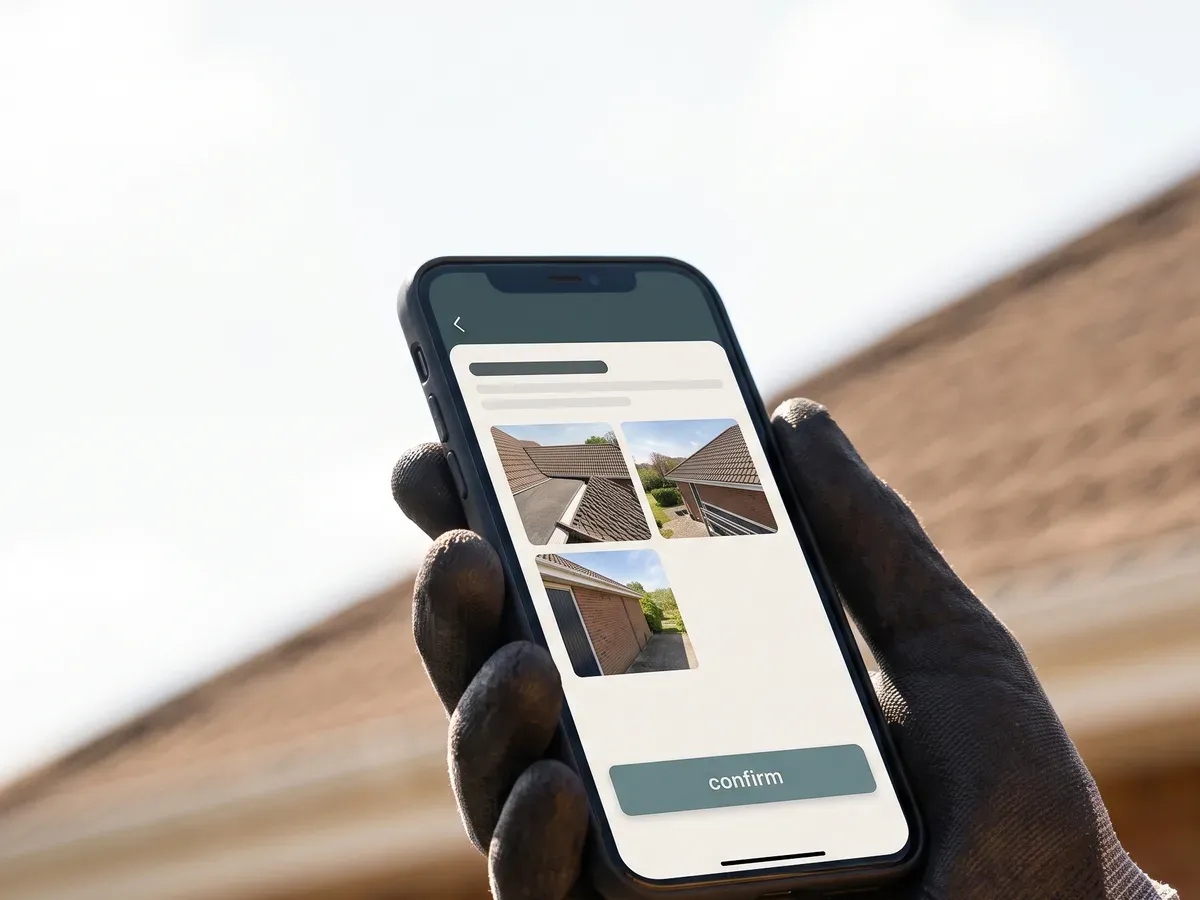
Yes, and on a roofing site it is the single most useful thing on the page. The form takes the picture with the message, and it arrives against the enquiry in your back office rather than in a separate email you have to match up later.
A photograph of a stain on a ceiling and a shot of the roof from the garden will often tell you whether it is a slipped tile or a failed valley before anybody gets in a van, which turns a free survey into a priced job.
Photographs are checked properly on the way in, so nobody can use your form to drop something nasty on you. And if a picture will not go through, the enquiry still lands, because losing the job to protect the photograph would be the wrong way round.
How a photograph arrives and gets answered →What happens to an enquiry after it arrives?
The message and the photograph land together as one job you can price without driving anywhere. Nobody asks that question until six months in, and it is the one that separates us from a web designer. Five agency sites were measured on 11 August 2026 and not one of them sells anything that happens after the form is submitted.
The enquiry lands in your own back office, photograph and all
Every enquiry on one list, with the message and the picture together. It is safe the second they press send, so an email provider having a bad afternoon cannot lose you a roof.
You answer it from the same screen
The reply goes from your own domain, in your name, and the exact words are kept against the enquiry. When they reply, that comes back in automatically and sits under it.
The enquiry becomes a job, in one press
Lead to quote, quote to job, job to invoiced. If a transition takes a page of manual steps nobody does it, and the records rot.
Your team see it on their phones, up on the scaffold
Today's jobs, the address, the customer and the access notes, and work marked done with photographs. Built for one hand, outdoors, on a bad signal.
The before and after settles the argument
Photographs taken on site, against the right job, with the date on them. That pair is what answers “it was like that when you got here”, and it is worth more on a roof than on any other trade because nobody else went up there.
AI goes on top, only when it earns its keep
Drafting the reply, chasing the quote nobody answered, pulling figures off a supplier invoice. Always as a draft a person approves, never sent on its own.
The back office comes with Growth and Full.
What goes on the page about schemes and registrations?
Whatever is true for you, checked on the register that issued it, with the date written down. The National Federation of Roofing Contractors runs a public membership list, and anybody can look a name up on it.
The federation also runs a Competent Person Scheme, which lets a registered roofer self-certify that refurbishment work meets building regulations. If you hold either, we show it in plain text with your number, because on this trade it is a real trust signal.
Your insurance, your guarantee and the photographs of finished work carry weight of their own, and they go on the page beside it.
How the words get written and checked →What does that photograph look like when it reaches you?
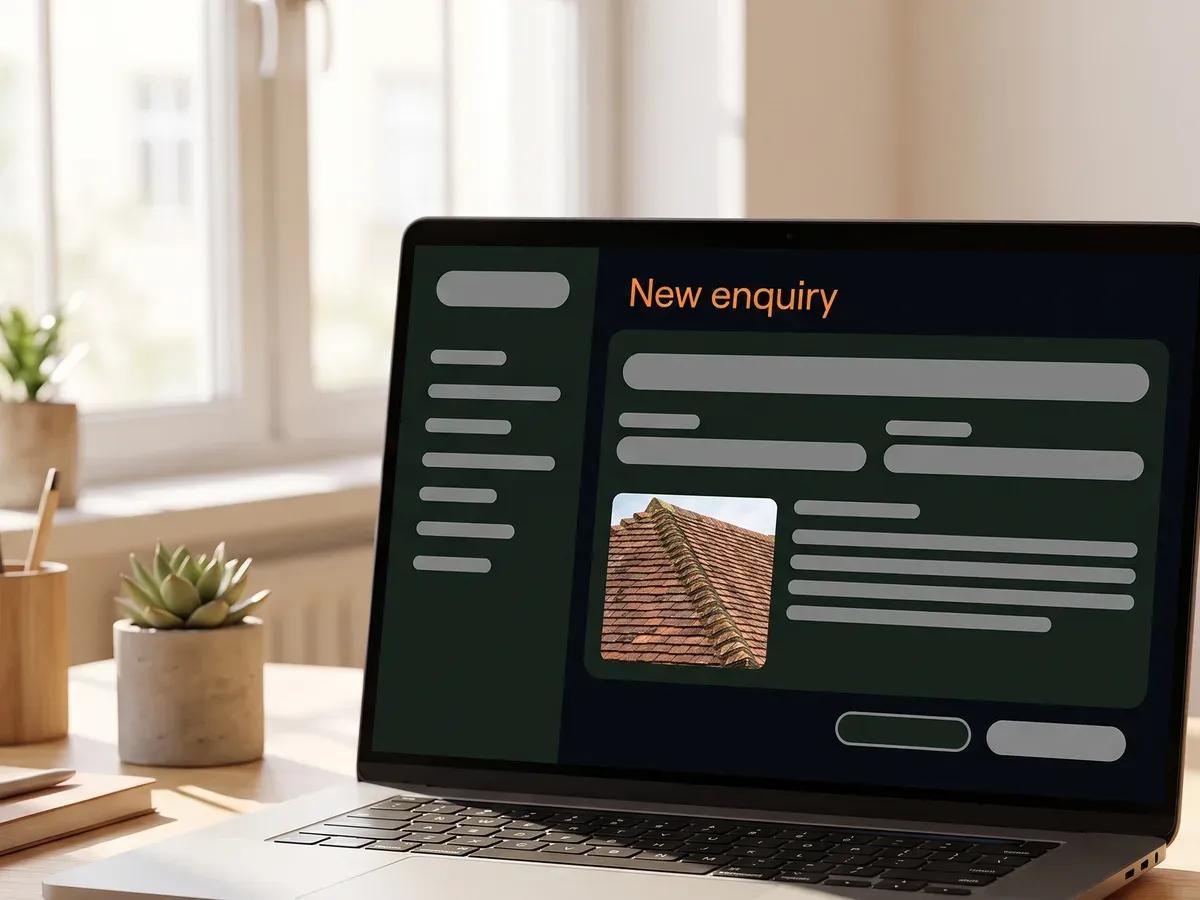
The photograph arrives attached to the enquiry rather than in a separate email you have to match up, which is the whole difference between pricing from the desk and driving out to look.
The message, the address and the picture are one row with a status on it, saved before anything is sent anywhere, and the reply goes back from your own domain and stays against the job. On a re-roof decided over a fortnight, that record is what stops the fourth conversation starting from nothing.
What a back office keeps beside a photograph →How much does a roofer's website cost?
Our prices are on the home page and they do not move depending on who is asking. Three of the five agencies measured make you request a quote, which usually means the number is decided after they have seen how much you can afford.
A one-off to build it, then a monthly to run it
The build is the site, the copy, the photographs organised, the Business Profile set up and the whole thing put live on your own domain. The monthly is hosting, changes, and keeping it working.
The back office and the staff app are the step up
Every plan starts with a website that works properly. The ones above it are where the enquiry becomes a job and your team gets the app. That is the difference you are paying for, said plainly.
Anything we pass through, we say so
Your domain, and your advertising budget if you run ads, are yours and go straight to whoever provides them. Our fee is our fee and it is never quoted as though it covered your spend.
Yours to keep
The site is yours, in your name, and so is everything in it. One month's notice, and that month is when we hand the lot over.
Every price we charge is on one page, with exactly what each tier covers.
How do I show work nobody can see from the ground?

With the photographs your lads are already taking on the scaffold, organised so a customer can find the job that looks like theirs. This is the one thing a roofer has that no national competitor can copy, and it is almost always sitting unused in somebody's camera roll.
We put the gallery on the site, we build the app so the pictures go straight from the phone to the job rather than into a WhatsApp group, and we take a proper set ourselves once a year if you are on the plan that includes it.
A customer who has seen a gallery of your finished roofs does not go looking for other quotes.
How your work gets photographed →Do the AI answers know about the firm?
Homeowners ask an assistant whether a roof is worth repairing before they ring anybody. The reply weighs it up and often names somebody. Google writes the same kind of answer at the top of an ordinary search now.
- Repair or replace is the question people are really asking, and it is the one worth answering in full. A page that answers it honestly is the page that gets quoted.
- Assistants match facts. The roof types you work on, whether you do scaffolding, your guarantee and the towns you cover all belong on the page as text.
- None of it is a separate service. Google's own guide says its AI answers are rooted in ordinary search ranking, so one page done properly covers both.
What does the money actually buy?
A page for every town you really put a scaffold up in. Google filters out pages aimed at towns a business does not cover, so a page for a town you never visit wins you nothing.
Listings on the registers a homeowner would actually search, rather than bought links. A page written when there is something real to say, such as a week of storm damage.
Live chat is switched on when the site is busy enough for it to be worth watching.
What we do charge for, on one page →What else is worth reading?
Every page here answers one question properly rather than skimming five. These are the others, and each one says what it is before you click it.
Websites for builders that chase the quote
A builder loses more work to quotes nobody answered than to missed calls. A site that takes the enquiry, and a back office that follows it up.
Websites for landscapers and gardeners
The work arrives in a rush every spring and then the phone stops. A site that takes the rush, a gallery you fill from your own phone, and the round.
Foothold AI: websites and AI for local service businesses
A website that gets found, a back office that runs the day, and an app for your team. From £295 to set up and £99 a month. Suffolk based, UK wide.
Where we work: Suffolk and north Essex
Twenty towns across Suffolk and north Essex, from Sudbury. Most are twenty or thirty minutes away, and the person who builds your site comes out.
What would it be worth to price a roof off a photograph?
Where the enquiries come from, what happens to them, and how many surveys you drive to. Nothing to pay for the conversation.
Nothing to pay, and nothing to sign. If you would rather read first, the home page has the prices and everything that is in each tier, and AI implementation is the separate track for automating a process rather than building a site.