A website for a decorator that gets the price out first.
Several decorators come and look at the same hallway. The one who sends the price that evening usually gets it, and it is almost never the cheapest one. We build the site, the back office that turns a visit into a quote before you have put the ladders away, and the app your lads use.
Interior and exterior, domestic and commercial. Suffolk, Essex and anywhere in the UK you can reach.
Why does the decorator who quotes first usually get the job?
Because a customer who has had three people round is not comparing craftsmanship, they are comparing who came back.
They cannot see the difference between your cutting in and somebody else's until it is done, so they decide on the thing they can see, which is who seemed organised and who made it easy.
A price that arrives the same evening, with the rooms listed and the paint named, does more work than any amount of copy about attention to detail. And it is not about being fast for its own sake: it is that the other two are still meaning to do it on Sunday.
Who answers while you are on a ladder →What does a decorator's website actually need to do?
Four things, and the fourth is the one that wins the job. The site and the back office together shorten the time between the visit and the price.
Get you into the house
Nobody prices decorating off a description, so the job of the page is the booked visit and not the phone call. A short form that asks which rooms and when suits, and a time that goes in your diary rather than into an inbox.
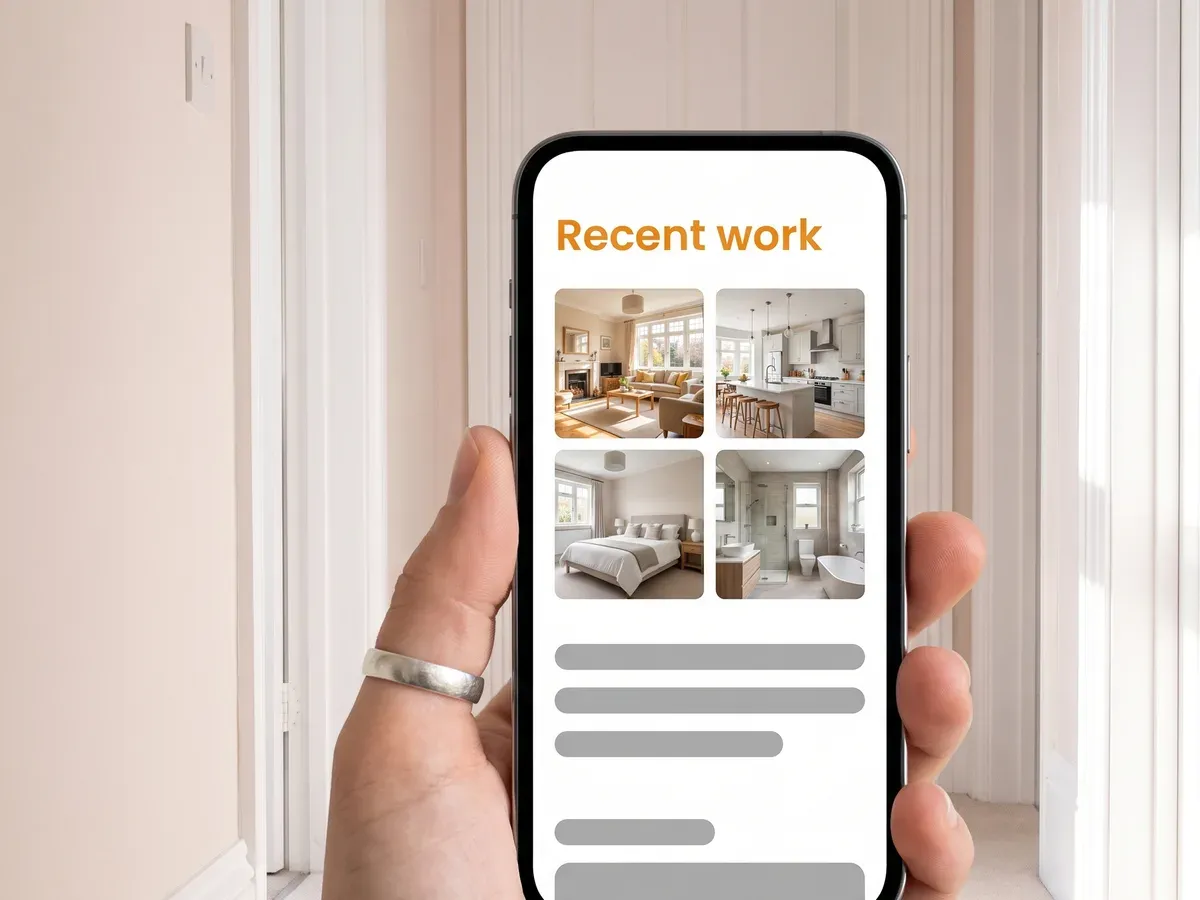
Show rooms, not projects
A hallway with the woodwork done properly, a bedroom in a colour somebody was nervous about, a stairwell nobody could reach. Customers are frightened it will look wrong, and the only cure for that is seeing a room like theirs finished.
Say what happens about the deposit
It is the thing they are actually anxious about and it is missing from nearly every decorator's site. What you ask for, when, and what protects it. One paragraph, and it settles the conversation they were dreading having.
Turn the visit into a price without an evening's typing
You price the same handful of jobs over and over. The quote should be mostly built by the time you are back in the van, and that is a back office job rather than a website one.
How do I quote fifty small jobs a year without living in a spreadsheet?

By pricing the job types once instead of pricing every job from scratch. A hallway, stairs and landing in one colour is not a new problem each time, and neither is a three bedroom repaint or a set of exterior windows.
Those become templates with your own rates behind them, so the visit produces a quote by choosing rooms and adjusting, rather than by typing the same paragraphs at half past eight at night.
What that buys you is not tidiness, it is turnaround: the difference between the price landing while they still remember you and landing on Saturday alongside two others. It is also the half that separates this from a website, because no amount of design shortens that gap.
How the quotes are raised and tracked →What happens to an enquiry after it arrives?
The enquiry turns into a booked visit, and the visit turns into a price before the evening has gone. Nobody asks that question until six months in, by which point the jobs that went to whoever answered first are somebody else's.
Five agency sites were measured on 11 August 2026 and not one of them sells anything that happens after the form is submitted.
The enquiry becomes a visit, in your diary
Not a message you have to answer to arrange a time. The enquiry carries the rooms, the postcode and when they are in, so the first reply can offer a slot rather than ask a question.
The quote is built from your own job types
Your rates, your wording, your terms, chosen rather than retyped. The same six jobs priced the same way every time, which is also how you stop underquoting the awkward ones.
Your quote goes out from your address and stays on the job
The exact words are kept, so when they ring in three weeks you are not reconstructing what you offered. Their reply comes back in automatically and sits under it.
The ones nobody answered come up as a list
Small jobs go quiet for ordinary reasons and a single polite follow-up wins a surprising number of them. The system remembers, so it is not a decision you have to make.
Your lads see the day on their phones
Which house, which rooms, which colours, and where the key is. Marked done with a photograph that goes straight onto the job rather than into a group chat.
AI goes on top, only when it earns its keep
Drafting the covering note, turning your voice memo from the van into the room list, chasing the quote nobody answered. Always as a draft a person approves, never sent on its own.
What goes on the page about schemes and registrations?
Whatever is true for you, checked on that scheme's own register with the date written down. If you are on the PDA or Dulux Select scheme we put it in plain text with your number. A customer can then do the same check in seconds.
The insurance, your deposit terms and how you work in a house somebody is living in carry just as much weight with a nervous customer. They go on the page too.
How the words get written and checked →What should the page say about deposits?
Exactly what you ask for and exactly what protects it, in plain words, before they have to ask.
This is the most useful paragraph on a decorator's website, and it is the one that feels like raising a doubt. It is the opposite: the customer already has the doubt, and you are the one who can settle it.
If you are Dulux Select there is a published rule to point at, because that scheme caps a deposit at 25% of the job value to a maximum of three thousand pounds and protects it under the guarantee.
If you are not on a scheme, plain words work just as well: what you ask for, when it is due, what it is for, and what happens if the job does not go ahead. We put whichever of those is true for you on the page, and we never write a figure you have not confirmed.
How the words get written and checked →How much does a decorator's website cost?
Our prices are on the home page and they do not move depending on who is asking. Three of the five agencies measured make you request a quote, which usually means the number is decided after they have seen how much you can afford.
A one-off to build it, then a monthly to run it
The build is the site, the copy, the photographs organised, the Business Profile set up and the whole thing put live on your own domain. The monthly is hosting, changes, and keeping it working.
The quoting is the reason to move up a plan
Every plan starts with a website that works properly. The job types, the templates and the app are the ones above it, and on this trade that is where the evenings go back.
Anything we pass through, we say so
Your domain, and your advertising budget if you run ads, are yours and go straight to whoever provides them. Our fee is our fee and it is never quoted as though it covered your spend.
Yours to keep
The site is yours, in your name, and so is everything in it. One month's notice, and that month is when we hand the lot over.
Where your money goes
- A page for every town you really work in. Google filters out pages aimed at towns you never decorate in, so those win you nothing and we do not make them.
- Listings on the registers a homeowner actually reads before letting somebody into the house. Earned entries, never bought links.
- A page written when there is something real to say, like a room you are proud of, rather than a post a week about nothing.
- Website chat when the visitor numbers make it worth manning. You are in somebody's house all day, so until then the money goes into being found by the people booking work now.
- Your own scheme number and the badges that were really given to you, in text a customer can look up in seconds.
Every price we charge is on one page, with exactly what each tier covers.
Will an assistant name us when somebody asks?
Customers describe the room rather than searching for a trade. They tell an assistant what they want doing and ask what it usually costs, and one answer comes back. Google writes the same sort of answer above the blue links now.
- What you take on has to be written down. Wallpaper, spraying, exterior work in winter, and whether you move the furniture are all facts an assistant can match.
- A price with a reason beside it beats a price list. A page saying what a three bedroom house usually comes to, and what changes it, answers what people are really asking.
- None of it is a fourth service. It is ordinary search work, which is Google's own position rather than ours.
What else is worth reading?
Every page here answers one question properly rather than skimming five. These are the others, and each one says what it is before you click it.
Websites for cleaning companies
You do not sell a job, you sell the same Tuesday for years. A site that opens the door and a back office that holds the rota when somebody is off.
Websites for salons and barbers
They decide at ten at night and you are cutting hair all day, so the phone loses you both. A site that takes the booking while the chair is full.
Foothold AI: websites and AI for local service businesses
A website that gets found, a back office that runs the day, and an app for your team. From £295 to set up and £99 a month. Suffolk based, UK wide.
Where we work: Suffolk and north Essex
Twenty towns across Suffolk and north Essex, from Sudbury. Most are twenty or thirty minutes away, and the person who builds your site comes out.
What would it be worth to send the price before you get home?
Where the enquiries come from, how long a quote actually takes you now, and how many you never sent. Nothing to pay for the conversation.
Nothing to pay, and nothing to sign. If you would rather read first, the home page has the prices and everything that is in each tier, and AI implementation is the separate track for automating a process rather than building a site.