A website for a joiner that fills the workshop.
Half your enquiries arrive as a photograph and the words “something like this”. A joinery website that works shows the pieces you have made and says how far ahead you are booked. It collects the room and the sizes with the message. We build that, and the system behind it.
Fitted furniture, staircases, doors, second fix and one-off pieces. Suffolk, Essex and anywhere in the UK you can reach.
Why do so many joinery enquiries never reach a price?
Because a one-off piece cannot be priced off a list, and the message rarely carries what you need to price it.
- “How much for a fitted wardrobe?” has no answer until somebody knows the room, the wall, the timber and the finish.
- So the enquiry becomes a visit, and an evening drawing something up for a job that was never going to happen.
A form that asks for the room, a rough size and a photograph changes that. Most of it becomes a conversation you can have from the workshop.
What does a joiner's website actually need to do?
Four things, and the second one is where joinery differs from every other trade we build for. Your pictures are not proof afterwards, they are the brief beforehand.
Name the pieces, not the trade
Fitted alcove units, a made to measure wardrobe, a staircase, a set of internal doors hung and finished, garden rooms, shopfitting. Nobody searches for joinery services.
Show enough work to be pointed at
A customer chooses by finding a piece close to what is in their head and saying “that one”. Twenty finished jobs, grouped by what they are, does more than any paragraph.
Serve the builder and the homeowner at once
One wants a price per unit and a date he can put in a programme. The other wants to know it is possible and roughly what it costs. Both routes are on the page and neither has to read the other.
Get in front of somebody who has not heard of you
A page for each thing you make, and a page for each town you work in. Both built so Google and the AI assistants can read every word without anything having to load first.
How do the fitters see what is going out this week?
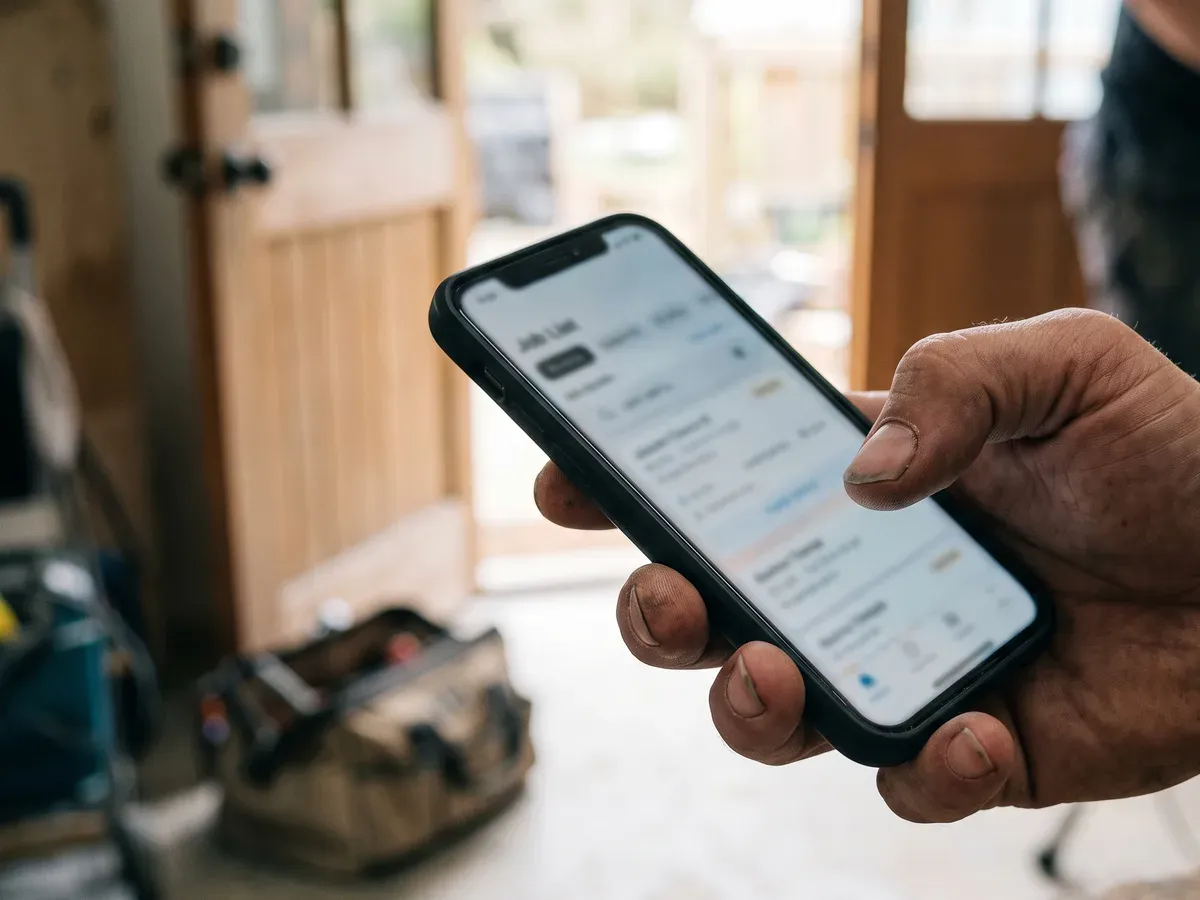
On their own phones, on the job, with the address, the customer and what is being fitted. Nobody rings the workshop to ask where they are meant to be.
Work is marked done with photographs taken on site, against the right job, on the day it happened. That is the pair that settles an argument about a finish six weeks later.
It is built for one hand, outdoors, on a bad signal, because that is where it gets used.
What happens to an enquiry after it arrives?
The message, the sizes and the photograph land as one job you can quote from without leaving the workshop. Nobody asks that question until six months in, and it is the one that separates us from a web designer. Five agency sites were measured on 11 August 2026 and not one of them sells anything that happens after the form is submitted.
The enquiry lands in your own back office, picture and all
Every enquiry on one list with where it has got to. It is safe the second they press send, so an email provider having a bad afternoon cannot lose you a staircase.
You answer it from the same screen
The reply goes from your own domain, in your name, and the words are kept against the enquiry. When they reply, that comes back in on its own and sits underneath.
The quote becomes a job, in one press
Enquiry to quote, quote to job, job to invoiced. If a step takes a page of manual work nobody does it, and by March the records are worth nothing.
Every drawing and revision sits with the job
The measure, the sketch, the timber they chose and the change they asked for on the phone. On a piece that takes ten weeks that record is the whole defence.
The finished piece is photographed against the job
Which means your gallery fills itself out of work you were doing anyway, rather than out of an afternoon somebody has to set aside.
AI goes on top, only when it earns its keep
Drafting the reply, chasing the quote nobody answered, pulling figures off a timber merchant's invoice. Always as a draft a person approves, never sent on its own.
The back office comes with Growth and Full.
Should the page say how far ahead I am booked?
Yes, and being booked ten weeks out reads as a recommendation rather than a problem.
The enquiries you lose to lead time are lost quietly. Somebody wants a wardrobe before Christmas, nobody says when you could start, and they go and ask the next workshop.
Put the real position on the page and two things happen. The people who cannot wait stop taking up your evenings. The ones who can wait book the slot instead of shopping around for a reply.
What does a joiner's website cost?
Our prices are published and they do not move depending on who is asking. Three of the five agencies measured make you request a quote first.
One payment to build it, then a monthly to run it
The build is the site, the words and your finished work organised into a gallery. It also covers your Google and Bing listings, and the whole thing live on your own name.
The back office and the app are the step up
Every plan starts with a website that works properly. Above it is where the enquiry becomes a job with drawings against it, and where your fitters get the phone app.
Photographs of the work are worth paying for once
A day in the workshop and in two finished rooms gives you a year of gallery. On this trade the pictures are what the quote gets written from.
Yours to keep
The site is yours, in your name, and so is every enquiry and every drawing in it. One month's notice, and that month is when we hand the lot over.
Every price we charge is on one page, with exactly what each tier covers.
What joiners ask us
About getting found, about the assistants your customers are starting to ask, and about moving a site without losing anything.
What actually gets me found for “joiner near me”?
Your Google and Bing listings, a page that answers what somebody typed, and real reviews. So that is where the work goes.
- Both listings set up properly, with the pieces you make listed individually rather than as one line saying carpentry.
- A page for each thing you make, because a wardrobe and a staircase are two different searches and one page cannot win both.
- Asking for a review built into finishing a job, so it happens without you remembering on a Sunday.
Do the AI answers know the workshop exists?
Some customers now describe the piece they want to an assistant and get one workshop named back. Google writes that kind of answer above the ordinary results as well.
- An assistant matches stated facts, not clever phrases. The timbers you work in, the pieces you make and how far you travel go on the page as text.
- A photograph is not readable and a caption is. So every picture of a finished piece says what it is, in words.
- None of it is a fourth thing to buy. Google's own guide says its AI answers are built on its ordinary search ranking.
What catches joiners out when they change website?
Losing the gallery, and losing the email. Years of photographs often live only inside the old site, and nobody thinks about them until the day it is switched off.
- Every picture comes off the old site first and is kept at full size, because a thumbnail is no use to you afterwards.
- Every mail record is written down before anything is changed, and the mail settings are left exactly where they are.
- The old site stays up until the new one is proved.
How many evenings went on quotes nobody took?
Where your enquiries come from, what arrives with them, and how many of them you drive out to measure. Nothing to pay for the conversation.
Nothing to pay, and nothing to sign. If you would rather read first, the home page has the prices and everything in each tier. Kitchen and bathroom fitters is the nearest page to this one.
What else is worth reading?
Every page here answers one question properly rather than skimming five. These are the others, and each one says what it is before you click it.
Websites for kitchen and bathroom fitters
A website that answers the mess, the dates and the price moving before the survey, and the back office that runs the job once they say yes.
Websites for tilers, judged on the finish
A tiling website built as a gallery of close-up work, that says what moves the price and takes the room and the sizes with the enquiry.
Foothold AI: websites and AI for local service businesses
A website that gets found, a back office that runs the day, and an app for your team. From £295 to set up and £99 a month. Suffolk based, UK wide.
Where we work: Suffolk and north Essex
Twenty towns across Suffolk and north Essex, from Sudbury. Most are twenty or thirty minutes away, and the person who builds your site comes out.