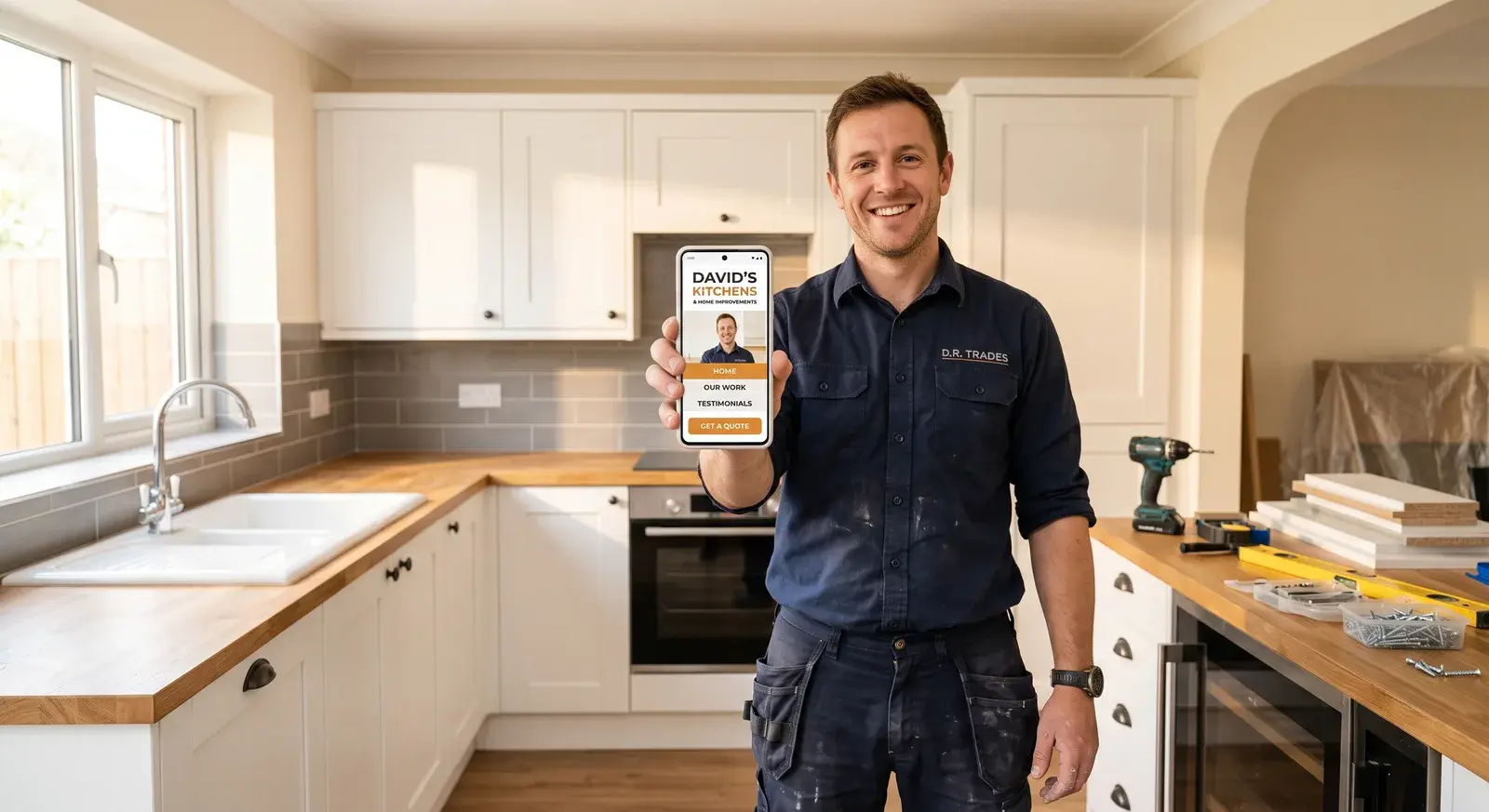
What makes a tradesman website bring in work?
What makes a tradesman website bring in work is not the design. It is whether somebody on a phone can understand what you do, see that other people trusted you, and contact you in one tap, before they lose patience. Almost every trade site that fails is failing on one of those three, and usually on the third.
I can be specific about this rather than theoretical, because on 13 August 2026 we measured every plumber in Colchester and every electrician in Sudbury that Google lists, then fetched each website and counted what was on it.
What did we actually find?
Uncomfortable reading, and I say that as somebody who builds these for a living.
Of seventeen Colchester plumbers:
- Five had no website at all on their Google listing.
- Four more had a website that did not answer or returned an error when we fetched it.
- Several of the rest had no form, no tappable phone link and no email link anywhere on the home page.
- One was served over plain http, which every modern browser marks as not secure.
- Several had under 300 words readable without JavaScript, meaning a search engine crawler sees almost nothing.
Of the electricians in Sudbury, the top seven results had no website at all.
Two things follow from that. The first is that the bar in most towns is far lower than people assume. The second is more useful: if you have no website, you are not unusual, and the thing to fix first is probably not a website. A Google Business Profile and a phone that gets answered will do more, faster.
Why do websites with no contact link even exist?
Because they were built to look like a brochure rather than to take an enquiry.
A brochure site describes the business. It has an About page, a Services page, a gallery, and a contact form at the end of a journey nobody completes. It was probably fine in 2012.
A site that brings in work assumes the visitor is on a phone, has a problem right now, and will give you about five seconds before going back to the map. Everything on the first screen exists to answer one question: can this person help me, and how do I reach them?
What actually goes on the first screen?
Four things, and nothing else has to be there.
What you do and where. Not a slogan. "Gas engineer covering Sudbury and Long Melford" beats "Quality you can trust" every time, because one of those is information.
A phone number that is a link. On a phone it should dial when tapped. This sounds trivial. It was missing from several of the sites we measured, and it is the single most common way a trade site loses somebody who was ready to ring.
One reason to believe you. A Gas Safe number, a real photograph of your actual van, a review with a name on it. One is enough. Nothing invented, ever, because a made-up claim on your own website is your legal problem and it is the kind of thing that surfaces at the worst possible moment.
A form that asks one thing at a time. A form asking for name, phone, email, address and a description of the problem in one screen is asking somebody standing in a flooded kitchen to fill in a form. Ask one question, then the next.
Does it need to be fast?
Yes, and this is measurable rather than a matter of taste.
Several sites we measured had a home page over a megabyte before a single image loaded. On a phone, on a normal signal, that is a wait long enough for somebody to give up.
The version that matters for a trade is simpler than the technical scoring suggests: open your own site on your own phone, on mobile data rather than the wifi, standing outside. If you find yourself waiting, so is every customer.
What about the search engine side?
Two things do most of the work, and neither is a trick.
The content has to be in the page. A significant number of the sites we measured had almost nothing readable without JavaScript running. Google says plainly in its JavaScript SEO basics that not all bots can run JavaScript, and Microsoft's webmaster guidelines warn that content that cannot be reliably rendered may not be indexed or used for grounding results. That second point matters more every month, because grounding is what feeds AI answers.
If your content only appears after scripts run, you are relying on every crawler in the chain doing optional work.
One page per real question, not one page per town. It is tempting to build a page for every service crossed with every town in the county. Google's systems remove near-duplicate pages before they compete, and one site generally will not hold more than a couple of positions in the same results anyway. A hundred thin pages cannot produce a hundred listings.
One genuinely good page that answers the question properly beats five that gesture at it.
What about design, then?
Design matters, but not in the way it gets sold.
Design's job is to make the four things above obvious in five seconds. That is it. A site that looks striking and hides the phone number has failed at the only test that counts.
Where design does earn its money is trust. A site that looks like it was built this decade, with real photographs of real work rather than stock images of somebody else's van, tells a customer you are still trading and you care. That is worth a lot when they are choosing between three names.
What should I do first?
If you have no website: your Google Business Profile, this week. It will do more than a website will, and it is free. There is a full order of work in how to get more work without paying for ads.
If you have a website that is not producing enquiries, in order: open it on your own phone on mobile data, check the phone number dials when tapped, check there is a form above the fold, and check what happens when somebody fills it in. That last one catches more problems than the other three combined. Send yourself a test enquiry and see how long it takes to reach you.
If it goes to an inbox nobody watches, the website is not the problem.
Where to stop
If the site is slow, invisible to search engines, or you cannot tell whether enquiries are arriving at all, that is a technical job rather than a design one and guessing at it wastes weeks.
We publish a free website check that measures the technical half and tells you what is actually wrong, and every price we charge is published on the AI implementation page. If you want the numbers on what a site should cost, how much should a tradesman pay for a website covers what other firms in this market publish, taken off their own pages.
Measurements in this post were taken on 13 August 2026 using Google's own places data, then fetching each site over the wire and counting what was in the HTML. No business is named, on purpose.