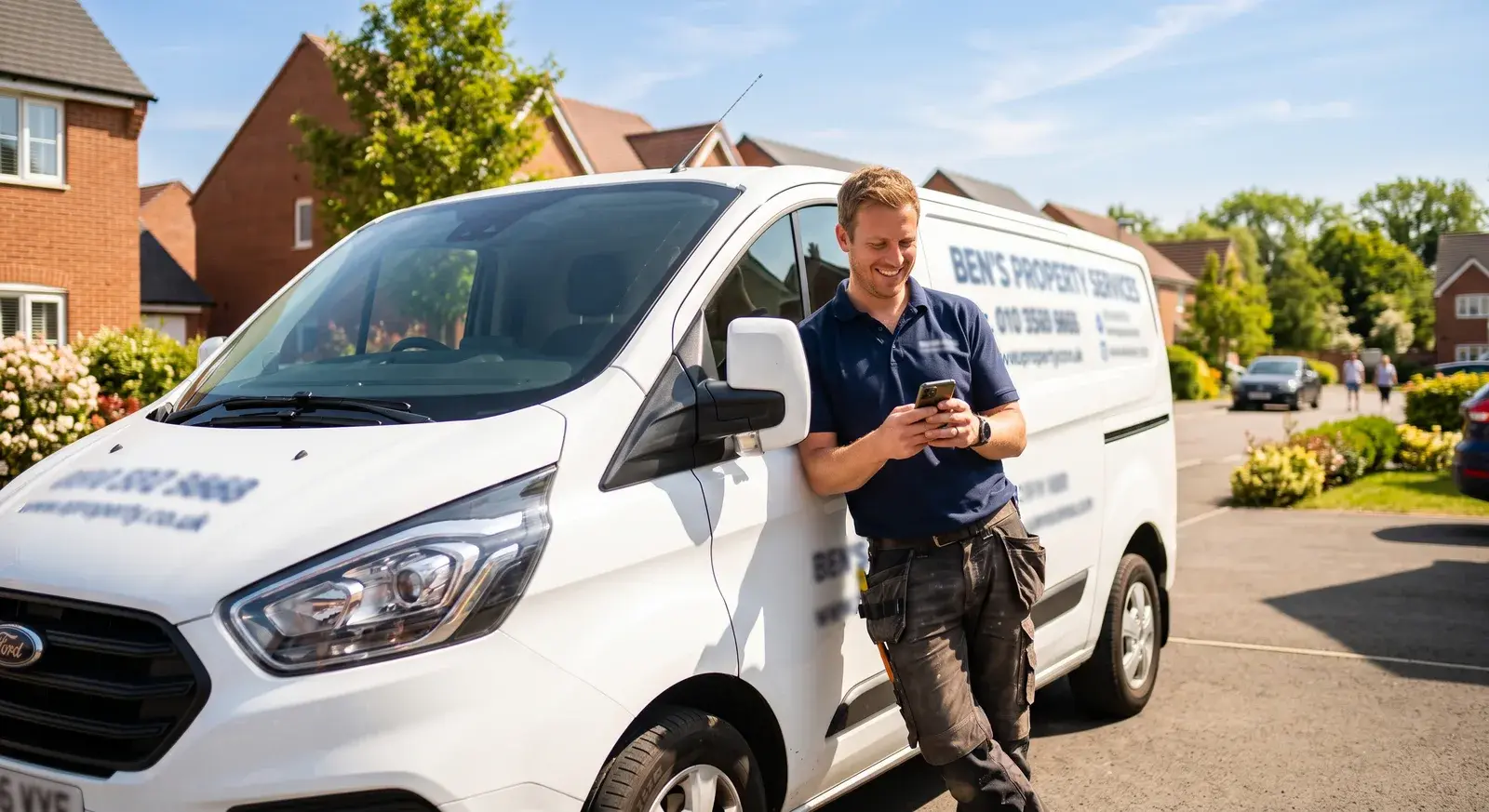
How do I get more work without paying for ads?
If you want to know how to get more work as a tradesman without paying for ads, do these four things in this order: claim and fill in your Google Business Profile properly, make sure people can actually contact you in one tap, ask every finished customer for an honest review, and answer the enquiries you already get faster. None of them cost anything except attention, and all four have to be working before advertising is anything other than a way to spend money quickly.
That last point is the one worth arguing about, so let me start there.
Why not just run ads?
Because advertising multiplies whatever is already happening, including nothing.
If your website loses most of the people who reach it, ads buy you more people to lose. If enquiries sit unanswered until Thursday, ads buy you more unanswered enquiries. The money goes out, the work does not come in, and the conclusion most trades draw is that advertising does not work for them.
Advertising worked fine. It was pointed at a leak.
So the order matters more than the tactics. Fix the free things, then pour money on the fire once it is actually lit.
What is the single highest-value free thing?
Your Google Business Profile, and it is not close.
For a local trade, the profile is doing more work than the website in most searches. Somebody types "electrician near me" and gets a map with three businesses on it. That is the whole shop window.
What actually moves it, from Google's own documentation rather than from a listicle:
- The category has to be right. Pick the one that describes what the business is, not everything it does. The categories are a fixed list in the profile. Do not let anybody invent one for you.
- The name must be your business name and nothing else. Adding service words or a town to the name is a stated cause of suspension. It is tempting and it is not worth it.
- Opening hours have to be true, including the ones you do not want to admit to.
- Service areas are places, not a radius. You cannot draw a circle.
One warning, because it catches people. If you do not meet customers in person during your stated hours, you may not be eligible for a profile at all. Google's own eligibility guidance excludes online-only businesses and lead generation companies. For a trade that visits people this is fine, but it is worth knowing the rule exists.
Can people actually contact you?
This sounds too obvious to be worth a heading. It is not.
When we measured the trades in our own patch on 13 August 2026, using Google's own places data and then fetching every website we found, the results were worse than expected.
Of seventeen plumbers in Colchester, five had no website at all on their listing, and four more had a site that did not answer or returned an error. Several of the rest had no form, no tappable phone link and no email link anywhere on the home page. One was still served over plain http, which every browser now marks as not secure.
In Sudbury, the top seven electricians had no website whatsoever.
That is not a criticism of them, they are busy. It is an opportunity. In most towns the bar is on the floor, and clearing it costs nothing but an afternoon.
The practical version: a phone number that is a tap-to-call link on a phone, one form above the fold that asks one thing at a time, and an email address that is not a free webmail account.
Do reviews really matter that much?
For local work, yes, and the mechanism is not mysterious. Somebody choosing between three names on a map picks the one other people vouched for.
The thing most trades get wrong is not asking. The thing some get dangerously wrong is offering something for it.
Asking is explicitly permitted by Google. Offering a discount, a prize draw or anything free in exchange is prohibited by Google and named in UK legislation. If a supplier offers you a review campaign with a raffle attached, that is your listing at risk, not theirs.
The rule that keeps you safe is one line: ask everybody, the same way, every time. Build it into the end of the job rather than into a campaign, so nobody is choosing who gets asked. The full detail is in asking for reviews without breaking the law.
What about speed?
This is the free one that beats most paid ones.
Somebody filling in a form on your site at nine in the evening is usually filling in two or three others. Whoever answers first has an enormous advantage, and it costs nothing to be that person.
You do not need software to start. You need the enquiry to reach your phone rather than an inbox you check on Sundays, and a reply that says something specific rather than "thanks for your enquiry, we will be in touch". If you cannot do the job, saying so quickly is still a win, because that person remembers you as the one who bothered.
Automating it is better, and it is cheap. But the manual version works and can start tomorrow.
What about writing content?
Worth doing, slower to pay, and easy to do badly.
The version that works for a trade is answering the questions customers actually ask you on the phone, one question per page, with the answer in the first paragraph. Not "10 tips for homeowners". The actual thing somebody typed at eleven at night.
The version that does not work is publishing a page for every service crossed with every town. Google's own ranking systems remove near-duplicate pages before they compete with each other, and one site generally will not hold more than a couple of spots in the same results anyway. A hundred thin pages cannot produce a hundred listings. It just looks like effort.
What order should I actually do this in?
- Google Business Profile, properly, this week.
- Make contact possible in one tap. Phone link, one simple form, a real email address.
- Ask every finished customer for an honest review. Same way, every time.
- Answer faster than the other three people they contacted.
- Then, and only then, consider paying for traffic.
Steps one to four cost nothing. If they are working and you still want more, advertising will do something useful. If they are not, it will not.
Where to stop
If you have tried all of this and the phone still is not ringing, the problem is usually either that you are not eligible or visible on the map at all, or that your website is invisible to search engines for a technical reason nobody has looked at. Both are findable in an afternoon by somebody who knows where to look.
We publish a free website check that measures the technical half, and every price we charge is on the AI implementation page rather than behind a sales call.